

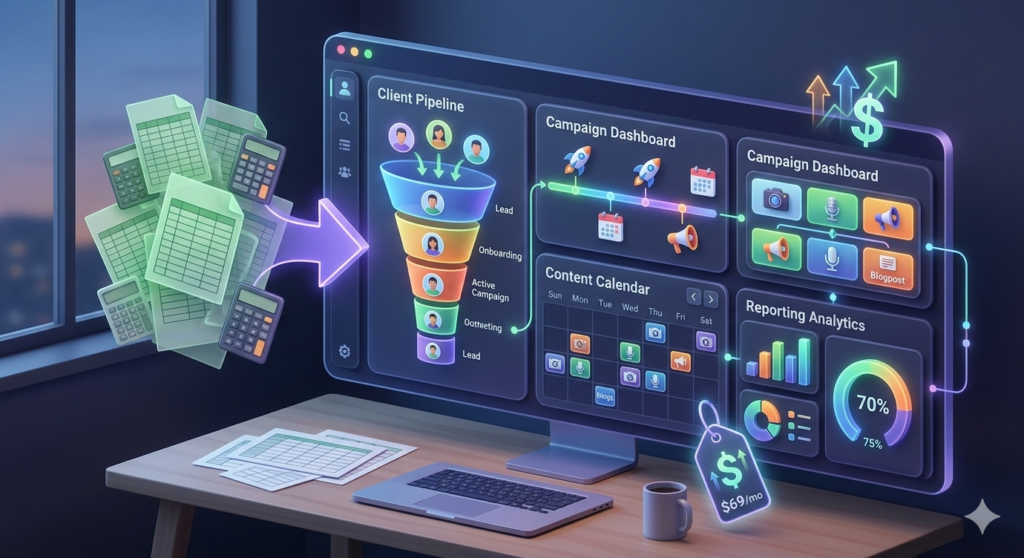
The first action that I would take is to design an Excel sheet of a replacement marketing company that will cost 69 monthly.
There is something I would like to confess.
I believed that I will be living a spreadsheet life in the agency.
Not ideal. Not fun. But normal.
In the case of a client who was to receive weekly reports, timetabling of a campaign, follow up of leads, content roadmap, approvals and an untidy hand over between account managers and media buyers, I have always envisioned that the answer to my question would always be, always some stack of Google sheets, Slack messages and half finished document. I also had a fair share of the pain to the point where I would no longer pose questions. I even had the time to become good at it. Tab color coded. Locked ranges. Lookup formulas. The entire situation.
I believed that I had been provided with the workflow.
No no I did not.
This was weirdly little as I thought of it. A friend of mine is a manager in a marketing firm that has a boutique and demonstrated how they can monitor deliverables of their clients. A single master sheet. A single status sheet. A single sheet of reporting. A single budget sheet. A different sort of consumption. Then there was a second article of exceptions because of the excessive untidiness of the first sheet.
It works, it does, said he, mainly.
Mostly.
I could not get rid of that word.
To a large extent, the agencies would be bleeding time. Not disastrously unsuccessful. In minuscule dragging plod. Repetitive 50 repeated 5-minute checks every week. In individuals within a team who pose questions, Which version is right? In the customers where the updates are postponed due to the forgetting of one of the customers to delete a row to add a tab.
That marked the turning point with me.
I no longer thought of the spreadsheets as the solution.
I began to think about them as what we were discussing.
And in the event that I were constructing one microSaaS to-morrow, this is the microSaaS I would construct.
An instrument of monthly marketing agency client business and creates a clean workflow system of a messy spreadsheet monitoring.
No huge supermarket.
No other swollen agency CRM.
One, very, very thing, and this is not like that it had been done well.
My Build to Buy MicroSaaS
I would devise a tool that would be known as ClientOps Board.
Simple name. Clear promise.
It would also assist the small marketing agencies to monitor on repeat work of clients, campaign request, approvals, due date and reporting status using the same operating system without using the spreadsheet as the operating system.
The buyer is not the maker of a 100 person agency.
The one who is frustrated with the necessity to change tabs, Slack, and Notion to be aware of the ongoing events is the owner or the operations lead of a 3 to 20 person agency.
The remark would be meagerly vulgar:
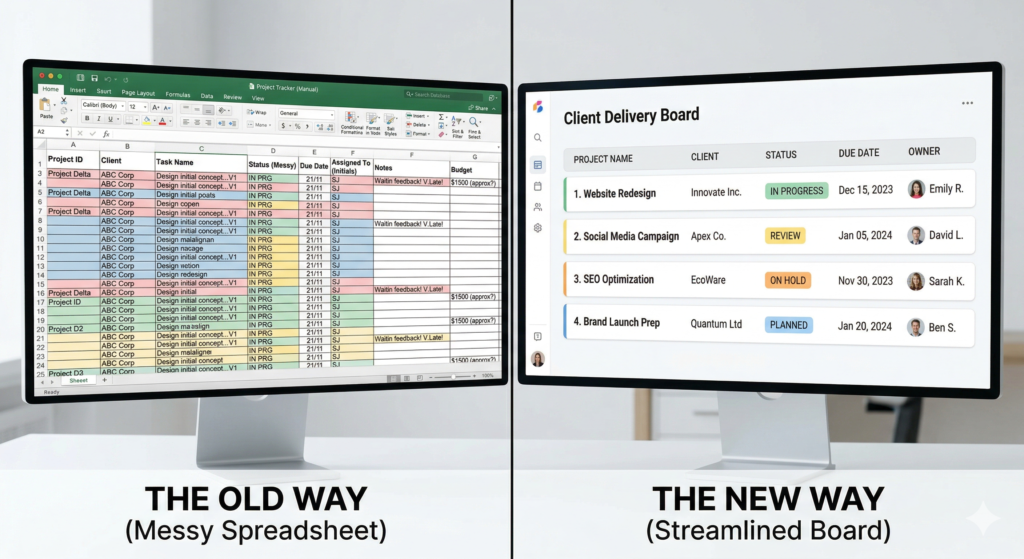
Abdicate the spreadsheet approach of delivering customers.
And here it is all over.
Not transformation of workflow.
Innoculate the release of synergies.
Why not get out of the spreadsheet madness.
Reporting Is Not the Real Problem
It clouds it Operational Fog It Is.
The initial idea that came to my mind regarding the product was that it would be seen on reporting dashboards.
And there is the apparent angle. Reporting is associated with agencies. It is regularly ordered by the clients.
However, it is not a deeper matter to report. It is the scramble and then reporting. The interrupted chain of communication, which results in the lack of updates, the mix of responsibilities and last minute rush.
The workflow that I would target is the following:
- Among the clients, there would be a desire to refresh the landing page
- Two more advertisement banners
- The performance overview of the current month
In an average small agency such request is divided in:
- An email communication
- A slack message
- Project board
- An Excel spreadsheet tracker
- Someone’s memory
Afterwards the team checks weekly after that to establish whether everything is moving.
Failure to perform in the job.
Reviewing work.
And that is the waste.
Rather than that, it would be replaced by the single repeatable flow of ClientOps Board:
- Capture request
- Assign owner
- Established deadline
- Bond and Campaign customer
- Among typical situations there is a circulation of gifts
- Mark dependencies
- Designated prohibited materials
- Trigger reporting checklist
- Send out customer prepared update
Not complicated.
Just clean.
Why this matters
Agency does not simply require information.
They should be confident.
They are supposed to be aware of what will happen to them, what is stuck, who owns what and what is awaited by the client without opening half a dozen tools and inquiring a client a question.
The former style is casual where the team size is small.
This novelty is repressive during a time span of approximately one day after which all the people settle down.
The Most Insignificant One Would Be the Smallest
At this point, I would tell you that founders commit an error.
They can already imagine the huge platform on which the agency operations can be seen, invoicing, CRM, reporting, white label dashboards, time tracking, proposal-making, AI summaries, and, possibly, a more approachable chatbot on the background as they listen to the agency operations.
Quite to the contrary, I would do the opposite.
The primitive edition must be nearly as grovellingly primitive.
The MVP will be as follows:
- Clientspace list This is the list of the workspaces of a particular client
- There exists repetitive templates of tasks
- Request intake form
- Status based Kanban board
- Owner assignment
- Due dates
- Client tags and campaign tags
- Waiting position of clients
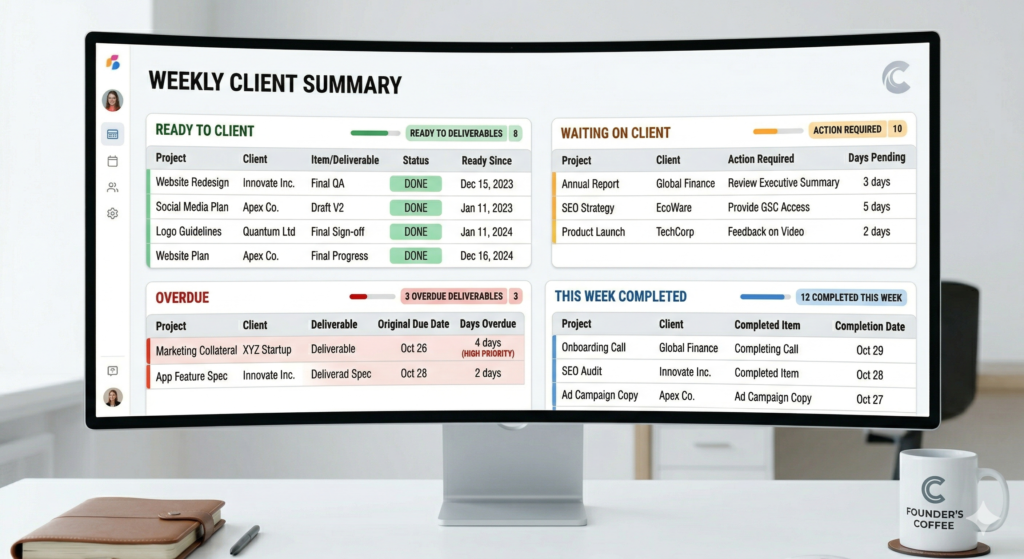
- Weekly overview perspective
- News about clients that can be exported
Enough said.
Only one automation is likely:
An item that has been updated to Ready to client is contained in a client update digest.
Done.
No languorous analysis to begin with.
No AI.
No billing.
There was a lack of team discussion.
In the first version, the role of impressing people does not exist.
To eliminate one headache a week is to eliminate it so satisfactorily that it will be willingly paid by a small agency.
Why this matters
The use of a tool becomes adopted when it can easily fit in the real life.
People are reluctant when the duration of installation is three hours.
They are not going to abandon them as long as they can import three customers, make templates on tasks and start using it within twenty minutes.
It is not such as software that should be the first handy version, but reprieve.
This Became Quite Clear Due to One Example of Personal Use Cases
Several months back, I was assisted in mapping a delivery process of a small service company. Other same mayhem, niche. The assignments to be done by the entire clients were reiterated. The compositions were slightly differentiated by their masters. All of us were telling us that we had a system. No one had faith in the system.
Thus we did a thing almost stupid easy.
We enumerated redundant deliverables. We classify them in groups of clients. We included owner, due date, dependency and status. Then we all pressed it into the open brook.
The other was the atmosphere.
Not that the work was lost.
The ambiguity was eliminated.
This is the merit of this here. Increased in the abstract not productivity. Rat race is not as ambiguous.
Agencies are not an exception to this.
The Offer Would Be Opinionated and Minute Simple
Solo teams would be billed at $69 a month.
Not even initially by seat.
Flat rate.
This is important because most of the times the buyer is involved in the mental calculations. They delay the decision in the hope they believe that the decision will become a costly instrument once another team member is introduced.
I would say, instead, the following:
The highest number of the team members was 10 and the active clients per month were 30 and 69 respectively.
The fact that it is priced that way conveys a number of important messages:
- This can be cheaply purchased even during a committee session
- This immense is serious not to be felt dispensable
- This will be less expensive than time wastage in a single hand off
The possibility is that I would provide an annual option of approximately 690 and two months free since agency owners are free to play around with figures when they are clean.
And one more thing, which I would put in with the offer, is:
Onboarding and delivery SOPs Notion template.
Not due to the fact that the product is founded on Notion.
It is practically guaranteed that the buyer already does.
The template is converted into a bridge to the product and lead magnet.

Why this matters
Software in itself can barely ever be a successful premature.
The second place is as not different as the first place.
When a person makes a purchase of a niche tool, he or she does not desire features in general. They desire more default mode of working the work.
My Personal Strategy of the First 10 Customers Without Ads
In fact, I find this aspect more interesting as compared to the product.
The initial 10 customers are not an issue of traffic.
They consist of mistrust.
I would begin with agencies, which already discuss messy delivery.
My research locations would include:
- Linked In updates of agency owners who aggregated regarding operations
- Agency and freelancing community post to Reddit
- Marketer slacks and Discord groups
- Also offered are freelancers with a growing list of agencies to which they submit
- Cold calling of 3 to 20 worker boutique agencies
However, the purchasing of my software is not what I would start with.
I would stiffen in the proposal:
I created a basic client operations system to smaller agencies which substitute spreadsheet monitoring. I will give feedback regarding 10 groups that are under white glove set up.
Yes, that is a yes much easier.
My ideal customer plan would appear as the one below:
- The deaggregated spreadsheet problem was represented in posts further elaborated in post 3
- Provide an example of uncoordinated flow of agency and the streamline one
- Provide the Notion template as a Free one
- Make personal calls to all the downloading owners of the agencies
- Book qualified teams through what is known as a 20 minutes setup call
- Establish their workflow with them
- Request them to send their findings so that they are converted into a case study
The latter is noteworthy.
In the case of two or more mini case studies, it becomes very easy to outreach.
Mini Case Study 1
This was a 5 person paid media agency and one master sheet was used by them to track the changes in the campaign, approvals, and monthly reporting.
On switching to iodine, the sample turned blue.
- Fewer internal status checks messages
- Quickly making calls to clients
- Enhancement on specification of ownership on deliverables
- Less scrambling of weekly summary sent
Mini Case Study 2
This would be succeeded by content agency that would trace the requests by the account managers to writers and designers.
Post change outcome:
- Reduced deadlines
- More straightforward monitoring of client approval
- A reduced number of questions on what has been blocked and what has fallen behind
These are not glitzy additions.
And that is what makes them sell.
They are brought to reality.
The Veritable Cons Are the Following
I cannot say that it is an interagency fit.
Two of its weaknesses are eminent.
To begin with, one can speak about teams that have been stagnating on the use of spreadsheets. They have not liked them, but they have had ten workarounds in the years. As it may appear, it will not be easy to make them change.
Second, the product might not be required, in the event that an agency has a fully developed project management structure that is very disciplined.
Third, integrations are significant in the short-term. The MVP has a chance to begin small, but individuals will be enthusiastic to be associated with Slack, Google Drive and reporting systems.
And fourth, the niche is specific. It is a strength and at the same time provides a limit to the ceiling unless the product is sent in the future during the workflows with its neighbors.
Nevertheless, I would accept this type of tradeoff.
Sharp goods are not taken seriously since they are small.
It Alters the Thinking of Your Mind About Agency Software
It is the backward mode of thinking:
In order to be able to work in complexity we must have a larger utility that is more functional.
The most recent trend is:
It is necessary to have something simpler that will do away with one of the sources of constant misunderstandings.
Everything that is that difference.
The founders are geared towards being whole that translates to creation of software that no one ever uses fully.
In an attempt to find clarity, they create software, which is left unattended by human beings during the day.
It is what I would like to prepare.
Not the mega-system of the agencies.
Something that can make Tuesday morning less aggravating.
Should You Care?
You must be wary whether you are one of them:
- The owner of the agency is a small agency which is overwhelmed by work of the repetitive clients
- We have a human glue operations leader, who is sick of being the human glue
- The account manager is in constant demand by in-house news
- One small-team consultant to one consultant
- A company that is in need of a microSaaS to a particular buyer
It is unlikely that you would want to be bothered whether you want venture scale story on day one.
It is not the case.
It is the type of business that is carried to revenue since it addresses a tedious problem in a commendable manner.
Personally, I would find that to be more exciting.
What I Suppose To Be the Next Things
In my view, the tool of this type would be successful over time as the tool would produce the workflow layer that would be located between the task management and the communication with the client.
No massive platforms.
Effective default-based systems.
And I would grow gradually in case this product succeeded:
- Slack notifications
- Client front facing update links
- Approval reminders
- Recurring checklists reporting
- Simple workload management
- Light can be used together with the ad reporting tools
The core loop will be strong only after it is completed.
It is that order.
Many computer applications are augmented and subsequently optimized.
I would strive as much as I can not to do so.
Activities That Can Be Carried Out To Build On This This Week
This is what I ought to do had I begun to-day:
- Give a one line promise
- Create the Notion template
- Note the course of the former and the later
- Design a single landing page including one problem statement
- Get to know 30 small agencies in person
- Provide a complimentary installation of the 10 first
- What they are doing with it at all
- Redundant cut can be done away with which is not contributing to the transparency of work in everyday life
- Charge early
- Make the product a torture
And there is the entire play.
Not clever.
Just disciplined.
Closing Reflection
The possibility of the technology being discovered in the future did not make me change my mind on this.
The awareness that much agony of agency lies concealed in processes which appear to be mundane was what this was.
You know when you have got used to the mayhem.
You guess that the system is the spreadsheet.
One day you come to discover that it is the spreadsheet with the symptom.
It is then that the totally varied nature of product concept is disclosed. Smaller. More practical. More believable.
And more erectable, more really, yes.
Taking into account the step I would make tomorrow to start a niche microSaaS, I would not address the screaming opportunity.
I would also follow the ones who hate and cannot avoid working with the workflow on a weekly basis.
And there is where the cash will probably be.
And this is where this one is.
So, what exactly have people been subjected to as far as work is concerned that is so angering and boring?
Please read my Medium articles from the links below.

Leave a Reply