

I would consider myself to be a freelance guru.
I also was a good one at it. I had learned how to write proposals within a limited time, how to deal with embarrassing requests of revision without appearing aggravated and how to receive calls where someone claimed that he or she just wanted to make it pop as though it is a good phrase to use.
At the face of it, I had formed a real online business.
I had designed myself a superior branded job indoors.
I suddenly became aware of that in a queerly banal manner.
Tuesday Zoom, I was smiling and nodding, and pretending that everything was all right, and this stabbing thought came to me:
I do not despise employment.
I detest this type of job.
That changed everything.
I had been surviving years assuming that what makes business online is all, selling time, dealing with clients and never showing them how valuable you are in a face to face discussion. However, as I began to take a closer look I discovered there was one additional category. Businesses that are still personal. Still lean. Still profitable.
Simply not constructed in an endless custom work.
This was the turning point of my case.
Notof work to naught to work.
From service work to scalable work.
These five online one person businesses seem to me the most reasonable in the event that you enjoy building, teaching, writing or solving problems, but do not want to spend your calendar in customers who want you to spend some time with them.
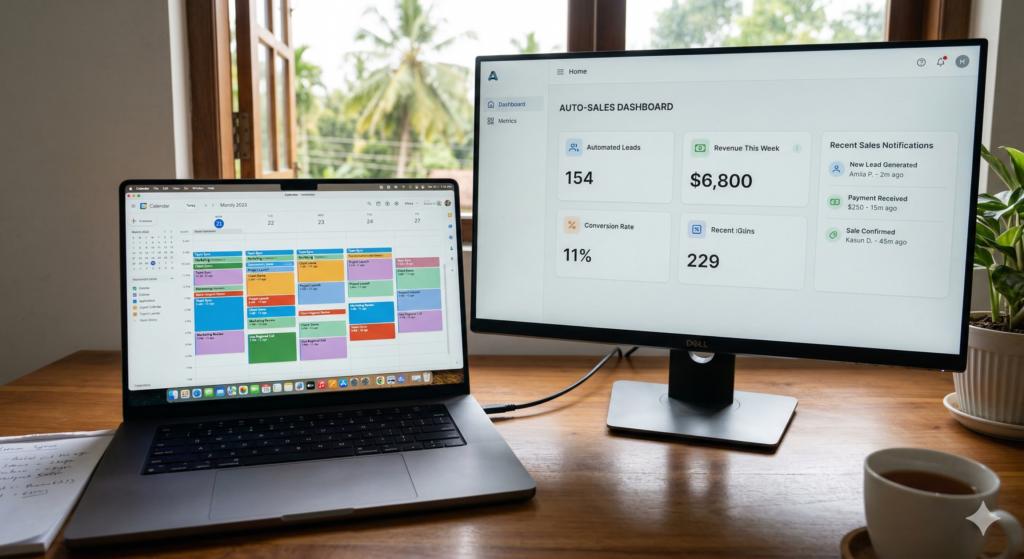
The Shift that Has Completely Changed My Personal Meaning of an Online Business
The former model was simple.
Find client.
Pitch client.
Do custom work.
Wait for feedback.
Revise.
Invoice.
Repeat.
The novel design was almost excessively clean.
Make something once. Improve it with time passing. Sell it many times.
This does not mean that it is simple. It does not mean that the effort accumulates but only means that it does not start every Monday again.
The disparity is huge more than what people are willing to acknowledge.
The lens that I am currently using is the following:
- Client work is a pay as you go.
- The future can be constructed with the help of scalable products.
- The optimum one person business puts you out of the middle of all the dealings.
- In case of more time, then it will be more margins and a more rational brain.
I will show you the models that proved to be effective with me.
1. Online Products Which Deal with One Irritating Problem Fairly Well
It was the initial model that gave me a feeling that I was able to breathe again.
A digital product is any product that can be downloaded or consumed without including any of your direct activity. Swipe files, calculators, templates, guides, prompt packs, checklists, mini toolkits, spreadsheets, Notion systems. Things like that.
Simple in theory.
Harder in practice.
Since the majority of the population attempts to create a massive masterpiece when what sells in reality is a very narrow focused shortcut.
I discovered this the shameful manner. My initial concept was an expansive one stop shop to online creators. It was overburdened with it. Too broad. Too vague. People liked it, however, no one was desperate about it.
Then I did a much smaller product to fix one issue a content planning system to assist people in freezing whenever they encounter a blank page.
That one sold.
Not wildly.
Not overnight.
But consistently.
What it does
It makes what you know a repeatable product that can be purchased by persons without necessarily calling you.
How I used it
My content planning template consisted of the following:
- weekly planning prompts
- a post idea bank
- a repurposing workflow
- an easy going publishing monitor
It took a weekend. I sold it at a rate that it seemed to be a no go. After that I made it better with the real questions of buyers.
Why this matters
You do not sell your work on an hourly basis anymore, you sell clarity.
That is quite another thing.
Old way: you are employed to bring his system out of nothing.
New way: they purchase system that you have already constructed.
Mini case study
A single selling marketer is one who markets your template, and pays you $29. They use it after every six months. You are not involved in a kickoff call. In search of an invoice never go. Do not characterize your scope.
Such is the entire argument.
Honest downsides
- You must be distributed, or to possess an audience, however small.
- Cheap products are subject to volume.
- Good products are killed by bad positioning.
2. Niche Content Websites That Run Like Growing Stagnant Assets
I would not consider content sites seriously since they were retro. Too much SEO talk. The number of individuals who promise passive income and work 14 hours per day is too high.
However, as soon as I realized the angle of assets, I looked at them in a new light.
A niche content site is nothing more than a specialized collection of useful articles on a single subject. You earn through advertisement, affiliate links, self products or any combination of all the three.
The gimmick is not in the creation of a blog.
It is to be of convenient resort.
What it does
It engages individuals by search or social discovery, and commercialises attention with no personal service.
How I used it
I experimented at a small place on a narrow topic of which I had some familiarity. Not entrepreneurship. Too broad. Not marketing. Also too broad.
I had selected a more narrow lane where intent of search was possible and repeated. I posted useful articles, which provided answers to particular questions, constructed comparison posts, and connected them into simple content clusters.
The sequence of work was as follows:
- worry about little things that one has to ask repeatedly
- compose clean up answers
- update the best pages on a regular basis
- contain helpful links or tips to products
Why this matters
A great article may keep on working long after it is written.
Client work also fades away on termination of the project.
A good page can get the traffic, months and even years later.
Comparison between the new and the old
Old fashioned: accept a pay to fix the issue of the single individual.
New way: resolve a single problem in public and have it discovered by thousands of people.
Honest downsides
- Slow at first
- Traffic in search may be unpredictable
- You have to wait and possess writing discipline
Yet, I would be more appropriate to such a model since it is charisma versus consistency.
And to many silent constructors it is a gift.
3. Medial Software Solutions to Mediocre, Unattractive Problems
This was what struck me as the most shocking.
I had assumed that software was something that startups, venture capital documents, and informally saying that we are pre seed but moving fast.
Not true.
The small company that creates single software can be extremely small, yet quite real. This is especially so in the current world where no code and low code tools can facilitate the development of lean tools without very huge team.
The most good ideas are normally dull.
That is quite a good indication.
What it does
It addresses one of the repetitive issues in software and asks the customers a recurrent payment or a single payment.
How I used it
One of my friends created a mini internal style content producer in the number of platforms. It de formatted, saved snippets and reformatted copy into channel specific forms.
Not flashy.
Useful.
That is why it was paid by people.
In construction of a building to day I would seek to discover such issues as:
- autonomous reformation and rearrangement of files
- rebranding content to new forms
- transforming unstructured inputs into the output
- simplifying the routine of the administrative work in a niche group
Why this matters
Software puts space between your revenue and your being.
You are no longer lifting everything uphill by the hand.
The product partially picks you up.
Mini case study
To take into account a case of a podcast editor who hates custom client projects. They devise an episode generator that takes transcripts and produces episode resources rather than editing an episode to include ten people.
- title ideas
- show notes structure
- social snippets
- timestamps
It is not their afternoons that they are selling anymore, but the system.
Honest downsides
- Support still exists
- Bugs happen
- Hype of launch is not as vital as retention
And despite such headaches, it is still usually cleaner than having to deal with six demanding clients at a go.
4. Paid Newsletters That Never Trust and Sell Before
The newsletters had not been originally understood by me.
I thought that they were more of an add on to marketing. It is something that comes after the real business.
Then I would be able to see how small teams of people created small and dedicated email newsletters around a particular point of view and realized that the newsletter was the business.
It transformed something in me.
The content of a paid or sponsor supported newsletter is not merely content. It is an intimate acquaintance with the people who make requests of your curation, opinion or practical advice in the very narrowest field.
What it does
It enables you to monetize the knowledge, taste, research, or pattern recognition through selling recurrent content.
How I used it
I started to write shorter and crisper emails relating to things that I was already experimenting with.
Not polished essays.
Like field notes not so much.
Nothing was like organization:
- one practical insight
- one real life example
- one useful takeaway
- one connection or suggestion
It was sustainable due to that rhythm.
Why this matters
It is the relationship to the audience you have.
No algorithmic mood swings. No dependence on a platform on whether you are relevant this week.
Old way: jump over platforms.
New way: build a room that people will desire to get into.
Honest downsides
- It is not possible to compromise consistency
- It can be tiresome to write with pressure
- You cannot be fast, you develop slowly
It is however one of the most human business models I have ever heard of those who are more productive in writing and hate meetings.
5. Web Based Courses that Train One, Not all You Know
Courses are now rightly scorned and some of that is understandable.
The number that are bloated is far too many. Too theoretical. Too drunk on the notion of making the creator sound intelligent.
Quite on the contrary, the courses that are most desirable are the reverse.
Tight.
Practical.
Outcome driven.
Business of one person course is a good business because you are imparting to people something that they can physically accomplish.
What it does
It encapsulates your process into a systematic learning process that people can undergo even without having one on one access to you.
How I used it
The biggest mistake was that I first tried to write a course outline. I attempted to enumerate it all.
Huge error.
The downsizing of the promise was what ultimately won. One outcome. One audience. One path.
For example:
- not learn content marketing
- but have 20 posts of authority published in 30 days
That is teachable. That is buyable.
Why this matters
Information is not bought by human beings.
They purchase the easy way out.
And when your course is the product of that way, it goes up much quicker than consulting.
Honest downsides
- The process of designing a good course is time consuming
- In some cases, graduation rate is pathetic
- You need experience, not philosophy
Worth it, though, in the event you truly love teaching and do not wish to make the commitment of live delivery a permanent one.
Should You Care?
Yes, when you are this kind of a man:
- In making helpful objects that you prefer
- you are tired of revisions and lack of feedback
- you would have revenue independent of you all day long
- you can submit to less immediate payment, in order to have the more leverage in the future
- than to have skills live the whole time you would prefer to construct systems
Perhaps not, since you enjoy working in a team, such as custom problem solving and, in fact, high touch client relationship.
Some people do.
As I have just been informed, I am not one of them.
What I Believe the Next Thing To Do is
I believe that more of one person business will start to appear more of an ecosystem rather than an individual offer.
- An online newsletter of products
- The introduction to a minor software tool
- A course is founded on a set template
Such mix is significant as it cannot be safe to rely on one source of revenues. However, a combination of two low maintainability assets may result in something becoming much stronger than it otherwise would have been.
Not passive.
But calmer.
And actually, serenity is not that significant.
And What Now to do Next in Case it Recks
The action that I would take is the following:
- List three problems that you are particularly aware of
- Give it a spin around the one which has been reworked and annoying enough on the pocket to pay money on it
- Select a format in which you are no longer being delivered
- Extend the smallest version that is useful
- Sell when you have not polished too much
- Easy to deal with actual objections, not perceived ones
The easiest to enter into will probably be digital products.
Content sites and newsletters should be used to make great betting in case you are interested in long term asset.
Tiny software is powerful in the event that you require recurring revenues and other systems of the sort.
Do not be too ambitious in your course results, lest you enjoy teaching.
Closing Reflection
The business model was not the only thing that was altered in my case.
The authorisation was the authorisation.
The privilege of dropping the pretence that an increase in clients would result in an increase in success. The authority to admit that I desired a business that suited my personality and not a business that could be seen outside to be legitimate.
And such was what was really found.
I did not need to become more available.
I had to make myself more upscalable.
And when it came before me I could not take away my eyes.
So now I am curious.
Which of the following appears to you now most: product development, newsletter development, course development, content asset development or small software tool development?

Leave a Reply