

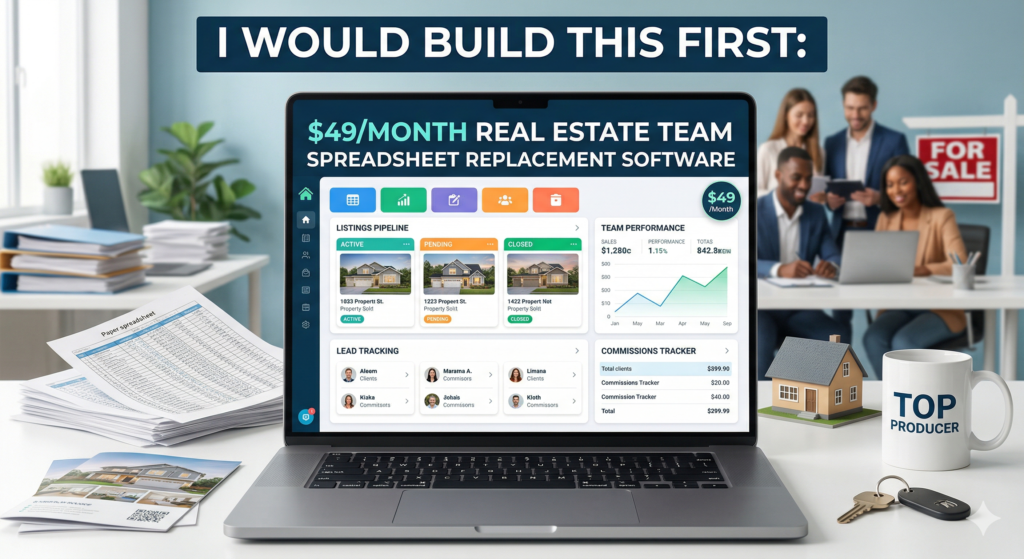
I have thought that spreadsheets were good enough to small real estate teams.
That was the area of my weakness.
I was guilty of this founder habit of looking at messy businesses and thinking that the disorder was part of the job. CRMs, shared drives, texting software, transaction coordinators, calendar applications, and so on, plus, as always, squarely in the middle of it all, an excel spreadsheet that held the entire mess together like duct tape to a leaky pipe.
I thought that was the norm.
Even efficient, somehow.
Then I did my time and saw how exactly a few small real estate groups worked. Not the polished one that they talk about on podcasts. The real version. The half updated version of Google sheets, the assistants that sent them quick check messages at 9:42 PM as well as the agents that asked the same question three times because nobody was certain that a listing packet was sent or not.
It was at that point that I changed my mind.
Not gradually.
All at once.
The spreadsheet was failing to help them to arrange work.
It was concealing the price of messiness.
And were I to build a microSaaS to-day, this is the first thing which I would build.
A no frills, real estate, listing launch tracking software, which does not purport to be a full CRM, lacks the bloated features and does not share the all in one platform fantasy.
Just one job.
Done properly.
The Workflow Nobody Is Talking About
The particular issue is coordination listing.
There is a set of minor details that have to come into place when a seller is secured. Photos must be predetermined. Copy needs approval. Yard sign should be placed out. Lockbox is to be installed. MLS details need to be checked. The listing packet is supposed to be examined. The launch date needs to stay intact.
And yet, in the situation with most smaller teams, such a process is present everywhere:
- one spreadsheet
- two group chats
- some sticky notes in somebody’s head
- interviews via email that nobody would care to search
- a transaction coordinator that has been developed to become the system
That latter is the actual trap.
When an individual is the system, the business appears to be running smoothly until the time this individual is on a day off.
I was able to see one group of 18 active listings and 1 operations assistant and 1 large spreadsheet. It was color coded. Tabs by month. Dropdowns. Comment cells. The entire affair appeared to be in order at a distance.
On a nearer look it was anarchy.
Nobody believed that the sheet was going to stop visiting Slack and text messages. Therefore every update was copied in other places. Which meant hard labor. More second guessing. More missed steps.
That is what type of pain I enjoy creating.
Not glamorous pain.
Useful pain.
The Product I Would Come Up With
I would establish a listing launch tracker at the real estate teams.
That is it.
Not a CRM. No transaction platform. No marketing suite. It is blocked and had been late only by a clean working place where all the listing are passed through a pre-established launch checklist and where everyone can see what has been done.
Imagine it as a status board that is developed to support the pre listing and go live operations.
The primary working process would look as follows:
- Create new property record
- Assign launch date
- Auto generate a default checklist
- Team member allocations
- Mark blockers
- View one board of all active listings
- Receive warning of deadlines
That is the least valuable product.
Not 40 features.
No profound integrations on the first day.
Only a common point of truth to enumerate preparedness.

The Least Significant Size to Ship
This is where a lot of founders get lost. Before they have version one, they build version seven.
I would maintain the MVP excruciatingly slim.
The first one would include the following only:
- Real estate information, address, seller, date of launch, agent, coordinator
- Checklist template, which includes such steps as photos, sign, lockbox, MLS draft, brochure, review
- Status board indicating columns like Not Started, In Progress, Waiting, Ready
- Email deadline notifications
- Notes on each step
- Team outlook on everything that is scheduled to be launched this week
That is enough.
In an occasion, the AI copywriting and marketing automation is not needed in day one. They must cease to ask, Wait, had somebody already done this?
The test I wish to use in this case is based on the following: when one of the teams can stop working with the spreadsheet after a single setup session, then the product is helpful. The product is not complete in case they need the spreadsheet as an emergency.
Why This Matters More Than It Seems
This seems to be at first a mere project management tool in a niche.
It is not.
The actual value is eliminating uncertainty.
That changes behavior.
Old way:
- Individuals request updates on demand
- Work gets repeated
- Memories of time constraints are emotional
- The most accountable individual becomes overloaded
New way:
- Status is evident without questioning
- Work has owners
- People do not have time constraints in their heads
- The team is able to identify risk prior to the launch date
The importance of change is that small real estate groups do not have the tendency of squandered time in dramatic ways. They are lost in minute leaks. Five minutes here. Fifteen there. A neglected sign erection. A revision of the copy that no one had viewed. One of the agents crossing the town because he thought nothing had been done.
That material multiplies.
A Real Life Situation Of How I Have Imagined It To Be
Suppose the team of five persons is ordered a new listing at 28 Lakeview Drive. it wants it alive next Thursday.
The tool entails the establishment of the property by the admin. Launch checklist is automatically available.
The due date of photos is Monday.
MLS draft by Tuesday.
Install sign Tuesday afternoon.
Final review Wednesday.
Go live in the morning, Thursday.
The listing coordinator assigns each item. The lead agent is able to look at the board and see that there are photos booked, copy waiting on seller approval and lockbox installation blocked since the seller has not confirmed access.
It does not compel one to send six messages to determine that.
There is no need to read color coded spreadsheet cells and hope that the comments were updated.
And when things go askew the tool indicates trouble before Thursday is a disaster.
And that is not a revolutionary technology.
It is merely the appropriate software at the appropriate location.
Mini Case Study 1: The Bottleneck Assistant
It is one of the trends that I can still see in service businesses.
It is all held together by her.
Sounds good.
Usually bad.
The business has not developed a procedure where the machine is only running due to the assistance of a single assistant. It has established dependency.
In this type of microSaaS, the assistant remains an important factor. They are currently operating an open system instead of selling a secret one.
That means:
- easier delegation
- faster onboarding
- fewer of the just checking messages
- less stress when a person is out of sick
It is an actual business result. Not just an aspect of the software.
Mini Case Study Two: The Team That Feels That They Are Too Small
Small teams tend to assert that they are listing to minimal numbers at a given time. We do not need a system.
I get the instinct. I really do.
However, that is precisely the time when a plain tool comes in handy.
When one acknowledges that the problem is complex, the complexity starts to crop up at an age of 6 to 20 active listing. The number of moving parts is sufficient to be confusing and not enough scale to warrant enterprise software. And this makes them go back to spreadsheet because spread sheets are low cost.
Cheap upfront, yes.
Expensive in attention.
It is because this tool dominates in that gray space, at which people are trying to run a real business and not to introduce more administrative support than needed.
The Rationale Of The Cost Of $49 Per Month
I like this price because it is not that high that one can buy it quickly and not that low that it can show the actual value.
When it saves: $49 per month can be easily justified in the case of real estate team.
- one failed launch of listing
- two hours of follow up administration a month
- one up and down spiral to prevent each week
The issue of pricing is also psychological.
Individuals will believe that it is a light utility at cost of 19 dollars.
They contrast its cost of $199 with full operations platforms.
At 49, it appears to be a specific team product, which resolves one annoying problem.
I would most likely organize it the following way:
- Infinite number of users in a team, up to 5, and costs 49/month
- It is 99 given bigger teams and templates and reporting
- no setup fee
- 14 day free trial
- concierge import from their existing spreadsheet
The latter is extremely essential.
When they are forced to reorganize their working process independently to adopt, a tension immediately arises.
The Way I Would Locate The Initial 10 Customers Without Advertisements
This part is not as mysterious as it is being presented.
I would not begin with paid acquisition or content funnels. I would begin with direct relevancy.
The strategy I would use in this case is as follows:
- Create a single page landing and have one promise: “Know precisely what listings are ready to be launched, without going on spreadsheets.”
- Demonstration of two minutes with fake properties
- Recruit people and team leaders through LinkedIn and Instagram
- Completely free setup of the initial 10 teams
- Ask every one of the early users to do a single warm introduction
- Become members of agent ops communities and discuss workflow, not software
The first 10 customers will most probably be of:
- boutique real estate organizations
- listing coordinators
- operations managers
- tooling influencing transaction coordinators
- not technical but aggravated team leaders
I would say the following:
“I created a lightweight listing launch tracker to allow small real estate teams using spreadsheets to see what has been done, what is blocked, and what is launching this week. Would you have me install it on one of your listings and demonstrate to you?”
No ad copy voice.
No fake urgency.
Nothing but a real offer having a real pain.
Checklist Landing Page Audit
Looking at the landing page of this product, the first checks I would make on the product are:
- Does the exact workflow problem identified in the title?
- Does the page clearly indicate who the page is targeted to?
- Has there been a screen shot above the fold?
- Is the copy a direct allusion to spreadsheets?
- Does it contain a clear and one-pointed call to action?
- Do they have realistic workflow?
- Is it visible or at least alluded pricing?
- Does it contain a short demonstration video?
- Is this page written up in plain English on setup?
- Will a team leader with a hectic schedule comprehend it within 20 seconds?
In the absence of those basics on the page, traffic is not the problem.
The page is.
It Might Be Constructed As A Simple Decision Tree
I would consider this in the following way:
- Do real estate teams already coordinate listing by use of spreadsheets?
- If yes, keep going
- Otherwise, this concept is not as strong as it seems
- Is it possible to substitute the spreadsheet with a single core workflow?
- If yes, build MVP
- Still, it is an excessively broad scope
- Would you get to know the value in a two minute demo?
- Sell manually, if yes
- Otherwise, rationalize product messages
- How many a lost launch or saved hour will be valuable to $49?
- Yes, and then pricing is effective
- Otherwise, sharpen pain or re-position buyer
- Do early users demand neighboring features?
- Yes, enumerate them but do not be in a hurry
- Otherwise, re-investing in the main use case
Real Failures And Disadvantages
I do not believe that it is an ideal business.
The barriers are self-evident in some ways:
- In lieu, there are groups that will seek to pressure their CRM to do so
- There are those who are so attached to spreadsheets to make a quick switch
- In a rush, integrations will be a demand
- It is niche and hence positioning has to be sharp
- It might not be the same person who is the buyer and daily user
Niche tools also can be derailed by feature requests. As soon as you start to introduce transaction management, lead tracking and marketing workflows, the product is lost.
That is the risk in the actual sense.
Success can make founders sloppy.
I Think It Is The Next Thing That Will Happen
Had this been so, I would not increase extensively at once.
I would dig deeper at first.
A few things I would have come to consider:
- reusable checklists templates by listing type
- seller approval steps
- simple vendor coordination
- launch delay reporting
- field updates mobile friendly
However, when the core board becomes indispensable then only.
It is not geared towards becoming large within a short period.
The aim is to get irritatingly useful.
Should You Care?
You have to take notice whether you are one of those people:
- a founder in search of a B2B microSaaS concept
- a numbing-problem operator with a fixed ROI
- a carpenter, and he will not squander his time on fancy technology
- When the pain is specific enough, a person who is mindful of the niche tools is superior to the generic tools
Probably, you do not have to worry about the fact that you are just fond of big markets and venture scale stories.
This is not that.
It is a silent company concept with good strengths.
My favorite kind.
What I Would Do Tomorrow Did I Build This To-Day
Very practical steps:
- Interview 10 real estate team administrators/coordinators
- Ask them to provide you with the screenshots of their current spreadsheet
- Graph the typical team to team checklist
- First, draw a workflow according to the board and checklist
- Develop a guide to onboarding
- Price in advance, despite a simple product
- Observe each onboarding session and make notes on areas of confusion
That is the path.
Nothing fancy.
Simply keen sight, narrow focus and actual dialogue.
The Section That Shifted My Opinion
I was not surprised since real estate teams were using spreadsheets.
It was the extent to which those spreadsheets were causing invisible stress to everyone as they all acted like they were okay.
I had assumed that this was the opportunity of replacing big software.
I now think that some of the best opportunities would be replacing small intolerated messes that everybody has silently put up with.
That is where this concept dwells.
Not in disruption.
In relief.
And really that is usually a far better place to start.
Admittedly, with the assumption that I would have to select one of the niche microSaaS to implement initially, it would be one of the best.
- Simple product
- Specific buyer
- Obvious pain
- Clear price
- Direct revenue approach
Hard to hate that.
What of you, have you seen a spreadsheet in the wild that was actually operating a business?

Leave a Reply